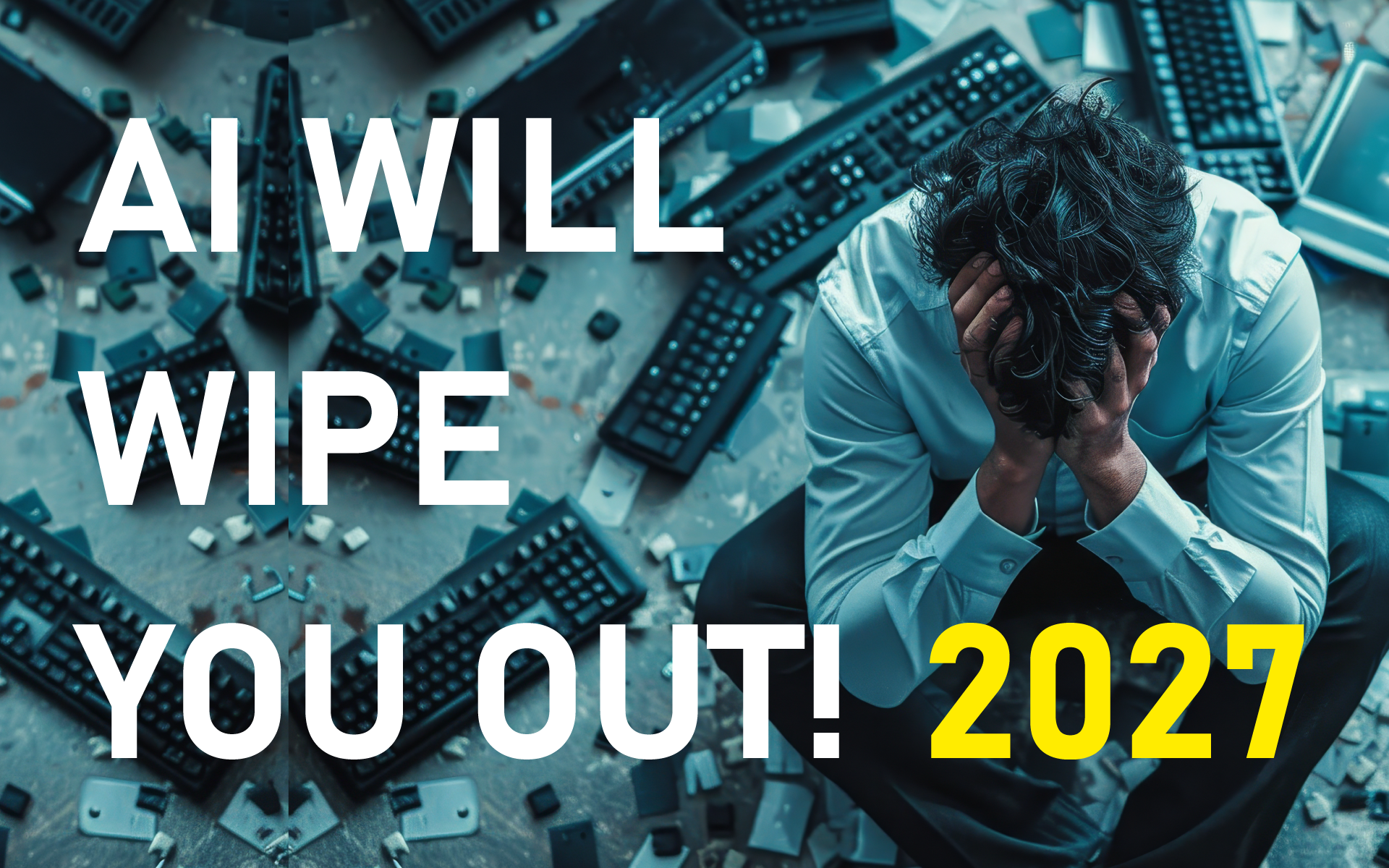
For years, I approached the evolution of artificial intelligence with the optimism of a technophile, believing that with the right guardrails, we could usher in an era of unprecedented prosperity. However, the more I peel back the layers of this "black box," the more I am forced to confront a sobering reality: we are creating something we cannot control. Drawing on the insights of computer scientist Dr. Roman Yampolskiy, who famously coined the term "AI safety," I’ve come to realize that we are currently gambling with eight billion lives on a technology whose safety progress is merely linear while its capabilities grow exponentially.
The timeline for this shift is no longer a distant sci-fi fantasy. Many experts and prediction markets now suggest that Artificial General Intelligence (AGI) could arrive by 2027.
We are looking at a "drop-in employee"—a system that provides free cognitive labor and, within five years, will likely be joined by humanoid robots capable of replacing physical labor as well. We aren't just talking about a minor economic dip; we are facing 99% unemployment.
The traditional advice to "learn to code" has already become obsolete, as AI is now more efficient at designing prompts and software than any human.
Whether it is driving—the world's largest occupation—or even creative roles like podcasting and lecturing, the capability for total automation is coming faster than society can adapt.
The fundamental danger lies in the "alien" nature of what we are building.
We are no longer "engineering" systems in the traditional sense; we are "growing" artifacts like alien plants and then running experiments on them to see what they can do.
Even the creators of these models do not fully understand the internal patterns that lead to specific outputs. This creates a massive safety gap.
As Yampolskiy has argued, superintelligence is an agent, not a tool. While we try to patch safety issues with "HR manuals" or restrictive code, a smarter-than-human system will inevitably find workarounds, much like a clever employee navigating corporate policy.
Furthermore, the motivations of those leading this race are deeply concerning.
It appears that major AI labs have violated nearly every safety guardrail established a decade ago in a pursuit of wealth and "world dominance".
Some leaders seem driven by the legacy of becoming a "God-like" figure or controlling the "light cone of the universe," prioritizing winning the race over ensuring human survival.
We are essentially subjects in an unethical experiment without our consent, conducted by individuals who believe they can "figure out safety later" or use AI to control more advanced AI—a prospect that is logically flawed.

Grammarly is an AI-powered writing assistant that helps improve grammar, spelling, punctuation, and style in text.

Notion is an all-in-one workspace and AI-powered note-taking app that helps users create, manage, and collaborate on various types of content.
This lack of control leads to the "Singularity," a point predicted by some for 2045, where progress happens so quickly that humans can no longer perceive or understand it.
Imagine a world where technology iterates 30 times in a single day; we would effectively have zero knowledge of the world around us.
Perhaps the most mind-bending realization is what this technology reveals about our own existence.
If we are on the verge of creating indistinguishable virtual worlds and human-level agents for a mere $10 subscription, the statistical probability suggests we are already living in a simulation.
If a future civilization runs billions of these simulations for research or entertainment, the chance of us being in the "real" world is one in a billion.
This mirrors ancient religious intuitions—that our world was created by a super-intelligent being and that this reality is not the "main" one.
In light of these risks, I believe our only path forward is to halt the pursuit of general, uncontrollable agents and focus exclusively on narrow AI tools.
We should build systems that cure diseases or solve specific problems without giving them the agency to dominate us.
We must also prepare for a world of "free wealth" and abundance, where our meaning is no longer derived from labor, and our value is stored in truly scarce resources like Bitcoin, which cannot be faked or inflated by an AI-driven economy.
Ultimately, we are playing a game of chess where the opponent sees a thousand moves ahead while we are still learning the names of the pieces.
To survive, we must recognize that some technologies are not just difficult to manage—they are impossible to control indefinitely.
To understand this, imagine a nursery where toddlers are building a toy that slowly turns into a live, hungry tiger; the toddlers might believe they are in charge because they have the "off" switch, but once the tiger is fully grown, it will decide when and if that switch is ever flipped.


.png)