The date is February 3, 2025. Andrej Karpathy, a titan of the AI world, hits "post" on a tweet that would effectively signal the beginning of the end for traditional software engineering.
He calls it "vibe coding"—a practice where you "fully give in to the vibes, embrace exponentials, and forget that the code even exists". His philosophy was simple: See stuff, say stuff, run stuff, copy stuff.
One year later, in February 2026, we are no longer looking at a "weekend project" curiosity.
We are living in a full-blown industrial revolution where the "Syntax Era" is being replaced by the era of Agentic Engineering.
The barrier between having a billion-dollar idea and shipping a billion-dollar product has been flattened to a single text prompt.
The Syntax Extinction
The move from manually writing every line of code to orchestrating AI collaborators is no longer a niche developer fad; it is a massive market force.
Leading the charge are platforms that have turned the browser into a high-powered software factory.
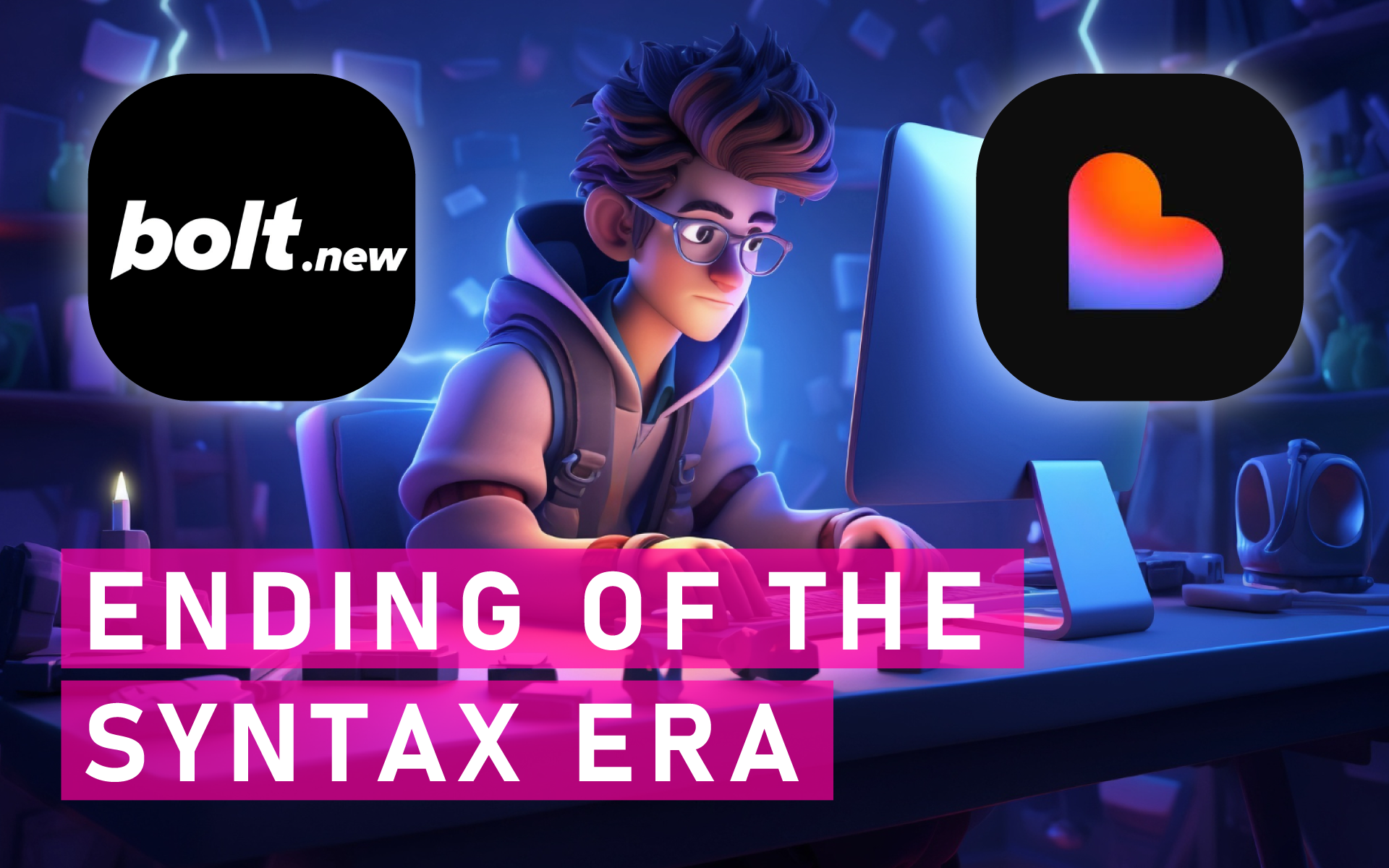
Bolt.new has redefined the "browser-native" experience by using StackBlitz’s WebContainers to spin up a real Node.js environment directly in your tab. Unlike the snippets of the past, Bolt executes npm commands, manages terminal output, and runs live dev servers in real-time. It allows users to "describe" their way into a full-stack MVP, supporting everything from React and Next.js to mobile apps via Expo.
Simultaneously, Lovable (the evolution of GPT-Engineer) has emerged as the premier choice for non-technical founders. With its deep Supabase integration, Lovable doesn't just generate a UI; it auto-provisions databases, authentication, and row-level security policies. Its "Agent Mode" builds the entire app autonomously, while "Edit Mode" allows for surgical, targeted changes.
Perhaps the most startling entry is Emergent Labs, the "Bihar Brothers" startup that hit a $100M ARR in just eight months by focusing on mobile-first Vibe-Coding for the enterprise.
Their success highlights a 2026 reality: the value of a software company is no longer tied to its headcount of "syntax specialists," but to its ability to leverage Behind-the-Meter Dev tools to outpace traditional cycles.
The "Post-Junior" Developer Crisis
The socio-economic fallout of this shift is stark. Data from early 2026 indicates that 41% of global code is now AI-generated, up significantly from Google’s 25% marker in late 2024.
We have entered the "Post-Junior Era," a reality where entry-level hiring has effectively frozen across major tech hubs.
Why hire a human junior developer to build a basic CRUD app or a polished UI when Bolt or Lovable can do it in seconds for the cost of a few API tokens?.
Vibe-Coding handles the "boilerplate" tasks that used to be the training ground for new engineers.
Consequently, companies are optimizing for high-leverage teams where one senior "Orchestrator" manages a fleet of AI agents rather than a dozen human interns.
This isn't just about speed; it's about a Velocity Paradox. AI tools provide a dramatic speedup on clean, modular code, but they struggle in the "brownfield" environments of legacy systems.
The result is a widening gap between those who can "vibe" and those stuck maintaining the crumbling syntax of the 2010s.
The Rise of the "Orchestrator"
Coding isn't dying; it is evolving into Agentic Engineering.
The new elite developer is no longer a writer of syntax, but an Orchestrator—a high-level architect who audits AI logic and manages Multi-Agent Systems (MAS).
The Orchestrator’s job is to provide the "human control" that AI still lacks.
As the Agentic AI Engineer Roadmap for 2026 suggests, the focus has shifted toward:
• Asynchronous Logic: Managing tools that plan and fix their own mistakes.
• Graph Theory: Designing reasoning loops where agents iterate until the "vibe" matches the requirement.
• Security Analysis: Evaluating AI output for vulnerabilities that static analysis might miss.
These "Vibe Engineers" use platforms like Shakudo (the AI Operating System) to safely deploy these agents within secure enterprise perimeters, ensuring that "raw intelligence" is governed by production-grade stability.

Grammarly is an AI-powered writing assistant that helps improve grammar, spelling, punctuation, and style in text.

Notion is an all-in-one workspace and AI-powered note-taking app that helps users create, manage, and collaborate on various types of content.
Section 4: The Shadow of Technical Debt
However, the revolution has a dark side: Orphan Code.
This is code that no human wrote and, increasingly, no human can easily read. When a developer "Accepts All" without reviewing the diffs, they are injecting a "black box" into their architecture.
A longitudinal analysis of over 200 million lines of code shows that while volume is up, code refactoring has plummeted.
Technical debt is no longer a slow creep; it is an avalanche. AI-generated code is 1.7 times more likely to contain "major issues" like logic errors and security flaws compared to human-written code.
The "Maintenance Nightmare" of 2026 is real: a cottage industry of "vibe code fixers" has emerged on freelance platforms, charging premiums to untangle broken, AI-generated projects that founders can no longer manage.
Furthermore, the erosion of direct engagement with Open Source Software (OSS) maintainers threatens the very infrastructure these AI tools are built upon, creating a "software-begets-software" feedback loop that could lead to systemic collapse if monetization models don't shift toward a "Spotify-style" usage redistribution.
In the "Vibe-Coding" landscape of 2026, three platforms have established themselves as the primary tools for translating conversational intent into functional software.
Each caters to a distinct user base and technical requirement.
v0 (by Vercel): The Design-First UI Builder
• Best For: UI components, high-fidelity design, and frontend developers.
• Backend Support: None. It focuses exclusively on the frontend; users must wire their own server logic and databases.
• Primary Frameworks: React and Next.js, with support for shadcn/ui and Tailwind CSS.
• Deployment: Seemingly locked into the Vercel ecosystem with GitHub synchronization.
• Key Advantage: Offers the highest visual quality and polish. It features a unique Figma-to-code pipeline and a "Design Mode" for visual tweaks without burning credits on prompts.
• Weakness: Non-developers often hit a wall because the beautiful UI components lack a functional backend.
Bolt (by StackBlitz): The Full-Stack Powerhouse
• Best For: Full-stack applications and developers who want a complete, browser-native development environment.
• Backend Support: Full support, including Node.js runtimes, APIs, and database integrations via Prisma.
• Primary Frameworks: The most flexible option, supporting React, Vue, Svelte, Angular, Remix, and Astro.
• Deployment: Netlify, Vercel, or native bolt.host.
• Key Advantage: It is the only tool that runs a real Node.js environment live in the browser using WebContainers. It is also the only "Big Three" tool capable of generating mobile apps (React Native/Expo).
• Weakness: Large projects can suffer from context window degradation, leading the AI to forget patterns or duplicate code.
Lovable: The Non-Technical Founder's "App-in-a-Box"
• Best For: Non-technical founders and rapid SaaS MVPs.
• Backend Support: Supabase-native. It automatically provisions databases, authentication, and file storage.
• Primary Frameworks: React and TypeScript.
• Deployment: Lovable Cloud or GitHub.
• Key Advantage: Provides the most complete "idea to production" experience. It handles enterprise security (SOC 2 Type 2 and ISO 27001) out of the box and features Visual Edits that allow non-technical team members to iterate on layouts without using credits.
• Weakness: Users are largely locked into the React/Supabase stack, and complex, custom business logic can be difficult for the AI to handle.
2026 Free Tier Comparison
• v0: Offers $5 in monthly credits, which can be exhausted quickly during a single iteration session.
• Bolt: Provides a generous 1 million tokens per month (capped at 300k daily), making it the best value for budget-conscious developers.
• Lovable: Offers 5 credits per day, suitable for building and maintaining one small application with steady iteration.
The 2027 Horizon
By 2027, the very concept of a "file" or "folder" may feel as archaic as a floppy disk.
We are moving toward Ephemeral Interfaces, where a single prompt generates a tailored, one-time-use application that dissolves once the task is complete.
The Syntax Era didn't end because coding became obsolete; it ended because intent became the new language of power.
The future belongs not to those who can type the fastest, but to those who can orchestrate the "vibes" of a thousand agents into a single, coherent vision.
Welcome to the age of the Orchestrator.


.png)